The Real Bachman’s Warbler
For readers who want to explore the bird behind the novel, this page gathers some of the best resources on its discovery, biology, habitat, searches, disappearance, and eventual declaration of extinction. I’ll continue adding reliable sources as I find them. All of these links take you to external sites in a new window.
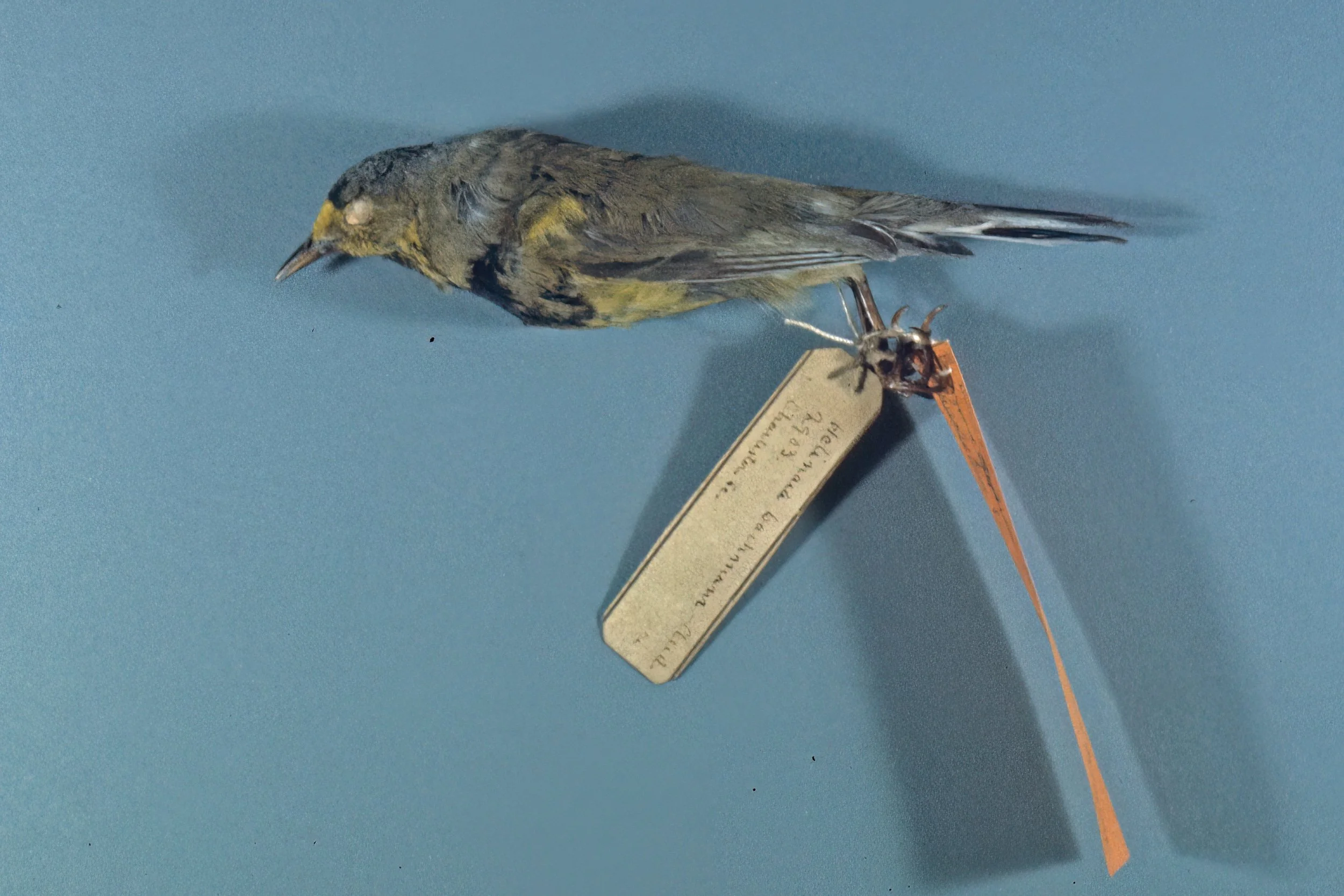
Original type specimen Bachman’s Warbler collected by Rev. John Bachman near Charleston, S.C, March 27, 1832. Photographed by Paul Hamel/Sidney Gauthreaux, Jr. in the collection of National Museum of Natural History, Smithsonian Institution, Washington, D.C.
U.S. Fish & Wildlife Service — Bachman’s Warbler
A concise species profile with identification details, taxonomy, historical range, and regulatory history. U.S. Fish & Wildlife Service species profile
Paul B. Hamel — Bachman’s Warbler: A Species in Peril
For anyone who wants to go deeper, this is probably the single most useful source. Hamel’s 2018 second edition reviews the bird’s biology and history and includes an extensive bibliography of the Bachman’s Warbler literature. Read or download A Species in Peril
Nesting Habitat of Bachman’s Warbler — Hooper & Hamel, 1977
This paper reviews historical descriptions of Bachman’s Warbler nesting habitat and tries to clarify the bird’s association with hardwood swamps, bottomlands, and dense understory. It is especially useful for understanding what researchers believed about the species during the period in which The Last Warbler is set. Read the nesting-habitat review
Macaulay Library — Historical Recording
A small number of historical recordings survive. This recording from May 15, 1954, near Fort Belvoir, Virginia, was made by Arthur A. Allen and Peter Paul Kellogg. Listen to Bachman’s Warbler at the Macaulay Library
Field Identification of Bachman’s Warbler
Paul B. Hamel and Sidney Gauthreaux, Jr. examined more than 400 specimens of Bachman’s Warbler to create a definitive summary of the field marks. Read the article.
Status of Bachman’s Warbler: A Progress Report — Hamel & Hooper, 1979
This report It summarizes systematic searches in South Carolina, Arkansas, and Missouri during the 1970s. The researchers reported 2,800 hours of searching over more than 17,000 acres without locating a Bachman’s Warbler, despite several reported sightings. Read the 1979 progress report
Audubon’s Bachman’s Warbler — Plate 185 (THREE RESOURCES)
—John James Audubon’s famous plate shows the male and female Bachman’s Warblers against a Franklinia background. U.S. Fish & Wildlife Service hosts a public-domain version of Audubon’s Bachman’s Warbler image in several downloadable sizes. View the public-domain Bachman’s Warbler image
—The Franklinia plant background in Plate 185 was actually painted by Maria Martin, John Bachman’s sister-in-law. Learn more about Maria Martin.
—Christoph Irmscher’s 2021 commentary on Audubon, Bachman, extinction, and Plate 185 provides historical perspective. Read Irmscher’s Commentary
U.S. Fish & Wildlife Service — 2023 Delisting
In 2023, the U.S. Fish & Wildlife Service finalized the removal of Bachman’s Warbler and 20 other species from the Endangered Species Act list because they were considered extinct. Read the Fish & Wildlife Service announcement